History of Galata Tower — From Byzantine Lighthouse to Ottoman Watchtower
The Earliest Beginnings: A Byzantine Watchtower (507 CE)
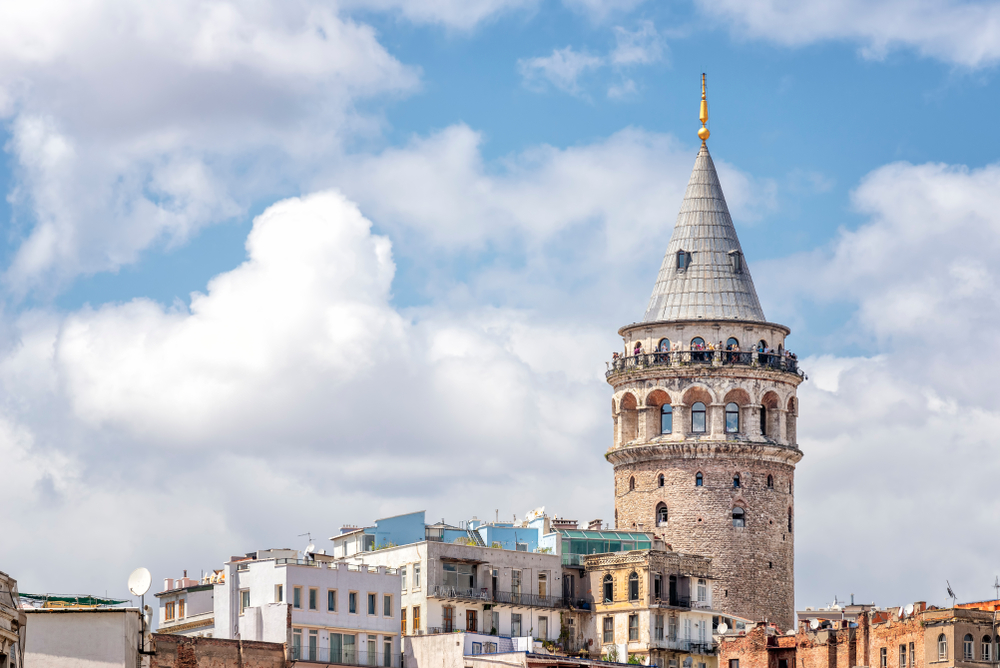
Long before the Genoese raised the stone tower that stands today, this strategic hilltop on the northern shore of the Golden Horn served as a lookout point. The Byzantine historian Cedrenus records that Emperor Anastasius I ordered the construction of a wooden tower here around 507 CE, intended to function as both a lighthouse and a surveillance point for monitoring ship traffic entering the Golden Horn.
This early structure was part of the broader Byzantine defensive network that protected Constantinople's maritime approaches. The Golden Horn — the natural harbor that gave Constantinople much of its strategic value — was vulnerable to naval attack from the north, and the hilltop above what would become the Galata neighborhood provided an ideal vantage point.
The original Byzantine tower was likely a modest wooden construction, nothing like the massive stone cylinder we see today. It was damaged or destroyed several times during the tumultuous centuries that followed, including during the Fourth Crusade in 1204, when Crusaders from Western Europe sacked Constantinople itself.
The Chain Across the Golden Horn
One of the most important defensive features connected to the Galata area was the great chain (zincir) that could be stretched across the mouth of the Golden Horn to block enemy ships. One end of this chain was anchored near the Galata shore, and watchers on the hilltop played a crucial role in determining when the chain should be raised or lowered. This defensive system was used successfully against Arab naval attacks in the 7th and 8th centuries and remained in use for hundreds of years.
The Genoese Colony and Construction (1273–1348)
The Treaty of Nymphaeum (1261)
The story of the tower as we know it begins not in Galata but in the town of Nymphaeum (modern Nif, near Izmir), where in 1261 the Byzantine Emperor Michael VIII Palaiologos signed a treaty with the Republic of Genoa. In exchange for Genoese naval support in recapturing Constantinople from the Latin Crusader states, Michael granted the Genoese extensive commercial privileges and a physical trading colony across the Golden Horn.
This colony, established on the hill above the waterfront, was initially modest. But Genoese commercial power grew rapidly, and by the early 14th century, the colony was a prosperous, semi-autonomous city-within-a-city. The Genoese built fortification walls, churches, warehouses, and residences — and they needed a tower.
Construction of Christea Turris (1348)
In 1348, at the height of Genoese commercial power in the eastern Mediterranean, the colony began construction of the tower that stands today. Named Christea Turris — the Tower of Christ — it was designed as the apex of the Genoese fortification system, the highest point of the defensive walls that encircled the colony.
The tower was built with local limestone and rubble-core construction techniques typical of 14th-century Genoese military architecture. The walls at the base are approximately 3.75 meters thick, tapering as they rise — a design that provided both structural stability and resistance to siege weapons. The total height reached approximately 62 meters, making it the tallest structure in all of Constantinople at the time of its completion.
The construction was financed by the Genoese colonial administration and supervised by military engineers from Genoa. The tower's position was carefully chosen: at 35 meters above sea level, the hilltop location combined with the tower's height gave watchers a sightline that extended across the Golden Horn to the Byzantine imperial capital, south to the Sea of Marmara, and east toward the Bosphorus.
The Genoese Fortification System
Christea Turris was not a standalone structure but the keystone of an extensive fortification system. The Genoese walls enclosed an area of approximately 37 hectares, with the tower positioned at the highest point within the enclosure. The walls featured several smaller towers at intervals, gates for controlling access, and a defensive ditch (fosse) on the landward side.
The colony was a remarkable example of medieval urban planning: the Genoese created their own legal system, their own harbor administration, their own churches, and their own governmental palace (the Palazzo del Comune). At its peak, the colony housed perhaps 10,000-15,000 people and generated customs revenue that sometimes exceeded that of Genoa itself.
Ottoman Conquest and Adaptation (1453–1717)
The Fall of Constantinople (May 29, 1453)
When Sultan Mehmed II besieged Constantinople in the spring of 1453, the Genoese colony of Galata officially declared neutrality — though individual Genoese fighters, most notably the commander Giovanni Giustiniani Longo, fought on the Byzantine side. The colony's neutrality was a pragmatic calculation: the Genoese knew that whoever won the siege would control the commercial lifelines of the eastern Mediterranean.
After Mehmed's forces breached the walls on May 29, 1453, the Galata colony submitted peacefully. The Sultan confirmed many of the Genoese commercial privileges, but the colony's semi-autonomous status was effectively ended. Critically, Mehmed ordered the demolition of the Genoese fortification walls — all of them except the tower itself, which he recognized as too useful to destroy.
Military and Civilian Uses
Under Ottoman rule, the tower was adapted for multiple purposes:
- Military observation: The tower provided an unmatched vantage point for monitoring both maritime and land approaches to the city.
- Prison: For periods, the tower held prisoners of war and political prisoners. Some accounts describe prisoners being lowered from the top in baskets.
- Astronomical observation: During the reign of Sultan Murad III (1574-1595), the astronomer Takiyuddin established a short-lived observatory near the tower.
- Fire watchtower: This would become the tower's most enduring and famous function.
The 1509 Earthquake
On September 14, 1509, a devastating earthquake struck Istanbul — an event so catastrophic it became known in Turkish as the Küçük Kıyamet (Little Apocalypse). The earthquake, estimated at magnitude 7.2, killed an estimated 10,000 people and damaged or destroyed thousands of buildings, including significant damage to Galata Tower.
The conical cap and upper portions of the tower were severely damaged. Ottoman engineers undertook repairs, and it is during this reconstruction that the tower began to diverge from its original Genoese appearance. The repairs introduced Ottoman architectural elements, though the basic cylindrical form was preserved.
The Fire Watchtower Era (1717–1875)
Becoming Istanbul's Fire Guardian
In 1717, the Ottoman authorities officially designated Galata Tower as the city's primary fire watchtower (yangın kulesi). This was a role of tremendous importance: Istanbul, built largely of wood, was devastated by fires with terrifying regularity. Major conflagrations could destroy thousands of homes in a single night, and early detection was quite literally a matter of life and death.
The fire watch system worked as follows: teams of fire wardens (bekçiler) were stationed at the top of the tower 24 hours a day, scanning the horizon for smoke. When a fire was spotted, the wardens would signal its location using a system of baskets, flags, and drums. The number and position of the signals indicated the district where the fire was burning, allowing firefighting teams to respond as quickly as possible.
This system was remarkably sophisticated for its era. The wardens developed detailed knowledge of the city's geography, and the signaling system was standardized so that firefighters throughout the city could interpret the warnings. The system remained in operation for over 150 years.
The Great Fire of 1794
On August 7, 1794, a major fire broke out in the Cibali neighborhood and spread rapidly across the Golden Horn into Galata. The fire reached the tower itself, badly damaging the wooden interior structures and the conical cap. Ironically, the very watchtower meant to protect the city from fire was itself consumed by one.
The Ottoman government undertook a major reconstruction of the tower following the 1794 fire. This reconstruction is significant because it gave Galata Tower much of its current appearance. The distinctive conical cap — the pointed top that makes the tower's silhouette so recognizable — was rebuilt to approximately its current form during this period. The interior wooden floors were also reconstructed.
The 1831 Fire and Further Modifications
Another devastating fire in 1831 again damaged the tower, requiring further repairs. During this period, the Ottoman authorities also added height to the tower: a two-story addition was built above the original Genoese structure, increasing the total height and improving the fire watchers' sightlines over the expanding city.
By the mid-19th century, Galata Tower had become one of Istanbul's most recognizable landmarks. European travelers invariably sketched or described it, and it appeared in early photographs of the city from the 1850s onward.
The Tanzimat to Republic Transition (1875–1967)
The End of the Fire Watch
By the 1870s, advances in urban infrastructure — including the development of a proper fire brigade, telegraph communication, and gradually less flammable building materials — made the ancient fire watch system obsolete. The last fire wardens left the tower around 1875, ending a tradition that had lasted over 150 years.
Without its primary function, the tower entered a period of uncertain purpose. It was used intermittently for various military and governmental functions, but no longer commanded the same importance it had enjoyed as the city's fire guardian.
The Galata Neighborhood Transforms
The period from the mid-19th century through the early Republic saw dramatic changes in the neighborhood around the tower. The Bankalar Caddesi (Banks Street) at the foot of the hill became Istanbul's financial center, housing the headquarters of the Ottoman Bank, foreign insurance companies, and trading houses. The Galata Bridge was rebuilt multiple times, becoming one of the city's iconic structures. The Tünel — the world's second-oldest underground railway (after London's Metropolitan Railway) — opened in 1875, connecting the Galata waterfront to the Pera (Beyoğlu) ridge.
Early Republic Period
After the founding of the Turkish Republic in 1923, the tower continued to serve various minor governmental functions. The neighborhood around it underwent demographic shifts as the cosmopolitan populations of the Ottoman era — Greeks, Armenians, Jews, Levantines — gradually diminished, especially after the population exchanges of the 1920s and the events of 1955.
Modern Restoration and Museum Conversion (1967–Present)
The 1967 Opening
In 1967, after a comprehensive structural restoration funded by the Turkish government, Galata Tower was opened to the public as a tourism venue for the first time. The restoration reinforced the masonry, rebuilt the interior staircases, and installed viewing platforms on the upper floors. A restaurant and nightclub were established at the top, which for decades were popular evening entertainment venues.
This period — from 1967 to 2020 — established Galata Tower as one of Istanbul's must-visit attractions. The tower appeared on postcards, tourism campaigns, and eventually became the unofficial symbol of the Beyoğlu district.
The 2020 Museum Conversion
In 2020, the Turkish Ministry of Culture and Tourism undertook a major renovation that transformed Galata Tower from a simple observation venue into a full museum. The renovation included:
- Installation of museum exhibitions on each floor, telling the story of the tower and its neighborhood through multimedia displays, historical artifacts, and informational panels in Turkish and English
- Restoration of the masonry and structural elements, including repointing of the exterior stonework
- Replacement of the elevator system to improve accessibility
- Renovation of the observation balcony, including safety improvements and interpretive signage identifying landmarks visible from the top
- New lighting design that illuminates the tower dramatically at night
- Updated visitor flow to manage the high volume of visitors more effectively
The renovation also revealed archaeological discoveries within the tower's walls, including traces of Genoese-era construction techniques and inscriptions.
UNESCO Tentative List
Galata Tower is currently on UNESCO's Tentative List for World Heritage Site inscription. Turkey nominated the tower as part of a broader initiative to gain recognition for Istanbul's Genoese heritage — a layer of the city's history that is less well-known internationally than the Byzantine and Ottoman periods but equally significant to the urban fabric of the modern city.
Galata Tower by the Numbers
| Fact | Detail |
|---|---|
| Original construction | 1348 (Genoese) |
| Earlier structure | c. 507 CE (Byzantine) |
| Height | 62.59 m (205 ft) |
| Wall thickness (base) | 3.75 m (12.3 ft) |
| Diameter (exterior) | 16.45 m (54 ft) |
| Diameter (interior) | 8.95 m (29.4 ft) |
| Number of floors | 9 |
| Elevation (hilltop) | 35 m above sea level |
| View altitude | ~140 m above sea level |
| Major earthquakes survived | 1509, 1766, 1894, 1999 |
| Major fires survived | 1794, 1831 |
| UNESCO status | Tentative List |
| Annual visitors | 3,000,000+ |
Further Reading
- Legends of Galata Tower — The extraordinary tales connected to this tower
- Architecture of Galata Tower — Genoese construction techniques and measurements
- Floor-by-Floor Guide — What to see on each level
- Neighborhood Guide — The history of the streets around the tower
Frequently Asked Questions
How old is Galata Tower?
The current stone structure dates to 1348, making it 678 years old as of 2026. However, a wooden tower or lighthouse existed on the same hilltop since at least 507 CE during the Byzantine era, giving the site a history spanning roughly 1,500 years.
Who built the current Galata Tower?
The current stone tower was built in 1348 by the Genoese colony of Galata (also called Pera). They named it 'Christea Turris' (Tower of Christ) and constructed it as the highest point of their fortification wall system surrounding the colony.
What was Galata Tower originally called?
The Genoese called it 'Christea Turris' (Tower of Christ) or 'Megalos Pyrgos' (Great Tower). During the Ottoman period, it was known as various names including 'Galata Kulesi' and occasionally 'Hezarfen Kulesi' after the legendary aviator.
Was Galata Tower used as a prison?
Yes, during the Ottoman period the tower was briefly used as a prison for prisoners of war. It also served as a fire watchtower, a military observation post, and a base for the Mehter (Ottoman military band) announcements.
When was Galata Tower last restored?
The most recent major restoration was completed in 2020, when the Turkish Ministry of Culture and Tourism renovated the interior, installed museum exhibitions on each floor, replaced the elevator system, and restored the observation balcony. Previous restorations occurred in 1967, 1875, and 1794.