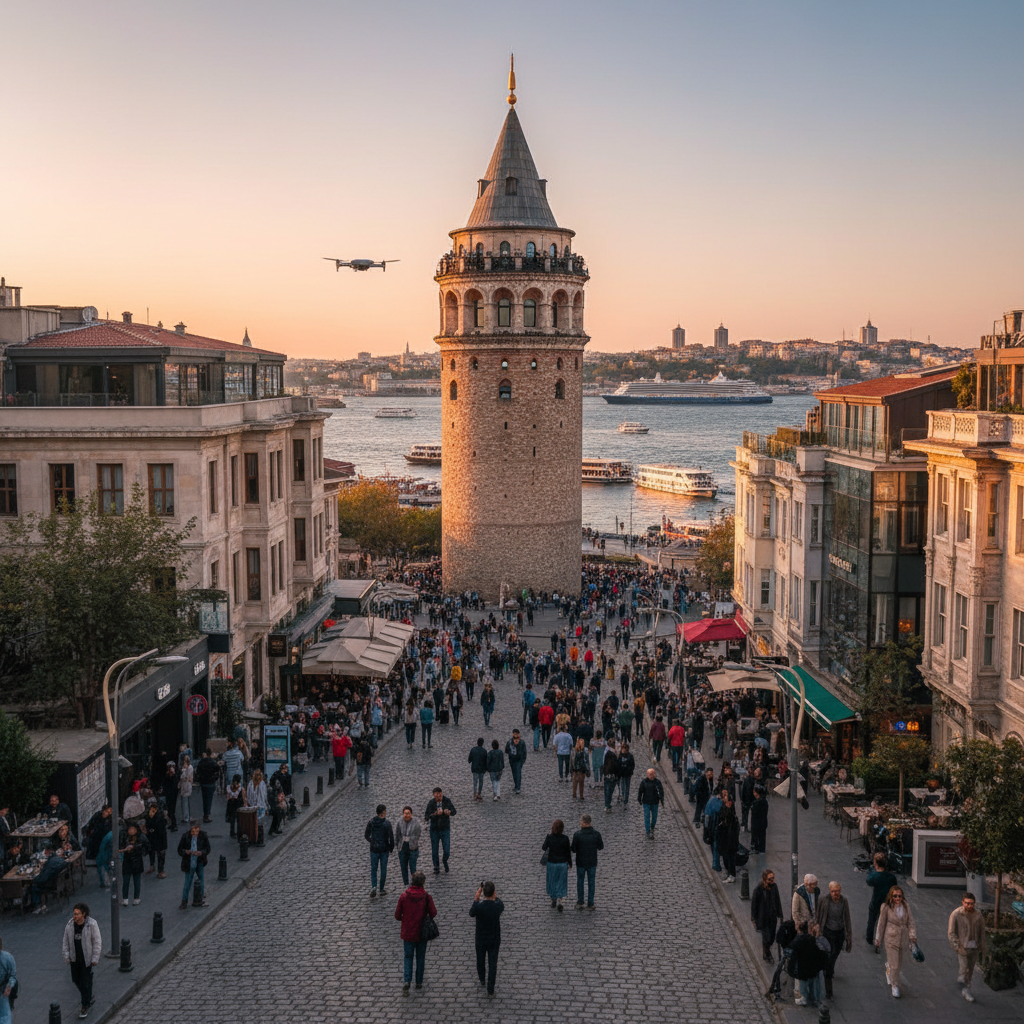
Zero Point of Galata Tower: Unraveling Istanbul's Historic Core
Adorning Istanbul's skyline for centuries, admired by every visitor, the Galata Tower is not just a structure but a symbol encompassing countless legends and historical facts. Especially in recent years, the growing popularity of the "Zero Point of Galata Tower" concept emphasizes the tower's central location in the heart of Istanbul and its historical significance. As we reach 2026, the meanings and unknown aspects that this ancient structure has carried from the past to the present continue to offer a fascinating area of discovery for tourists and history enthusiasts from all over the world. To delve deeper into its historical impact, you might be interested in our article on Galata Tower's unknown connections with Istanbul's walls and gates.
The Origins of the Zero Point of Galata Tower and its Historical Significance
The history of the Galata Tower, like Istanbul itself, is deep and layered. The first structure, believed to have been built in 507 AD, is thought to have been constructed as a lighthouse by Byzantine Emperor Anastasius. However, it acquired its form closest to its current state during the Genoese period, in 1348, under the name "Tower of Christ." From this period onwards, the tower was used both as a strategic observation point and a lighthouse.
So, what exactly does the term "Zero Point of Galata Tower" mean? This phrase actually refers to the tower's geographical and historical acceptance as the center of Istanbul. In old maps and navigation information, there are various popular beliefs and historical references stating that important points of the city were determined relative to this tower, and even kilometers were measured starting from here. This symbolizes not only a geographical marker but also the tower's place at the cultural and spiritual heart of the city. For a visual journey through its history, explore how the Galata Tower acted as a "Photographer of Bygone Eras".
Central Location in Ancient Maps
- In many ancient maps, the Galata Tower was shown as the reference point of Istanbul, truly the Zero Point of Galata Tower.
- For sailors, the tower served as a guide in determining the entrance to the Bosphorus and important points.
- Even after the conquest of the city, the Galata Tower maintained its strategic importance.
Architectural Marvel and Diverse Uses of the Zero Point of Galata Tower
The architecture of the Galata Tower perfectly reflects the engineering and aesthetic understanding of its era. Built by the Genoese, the tower shows influences of Gothic architecture, while gaining a much more solid and imposing appearance with additions made during the Ottoman period. Standing out with its 67-meter height, this structure is almost like a fortress with its approximately 3.75-meter-thick walls.
The tower has been used for a wide variety of purposes in different periods, solidifying its status as the Zero Point of Galata Tower:
- Defense Fortress: It played an important role in the defense of the city for the Genoese. For more on its defensive roles, read about its evolution from historic ship defense to a 2026 security hub.
- Observation Tower: A strategic point for observing the Bosphorus and its surroundings.
- Fire Watchtower: During the Ottoman period, especially from the 18th century onwards, it was used to detect large fires in Istanbul early.
- Dungeon: There are records indicating that it was used as a prison for a short period.
- Observatory: In the late 19th century, it hosted one of the first meteorological stations.
Late Ottoman and Republican Era Changes
In the late Ottoman Empire and the early years of the Republic, the Galata Tower underwent extensive maintenance and restorations. The work done during this period played a major role in its current appearance. Particularly, its opening to tourism with comprehensive restoration in the 1960s was key to the tower's current popularity. Visitors have the opportunity to witness the history and cultural fabric of the city while enjoying the unique 360-degree panoramic view of Istanbul from the top of the tower. This unique perspective eloquently demonstrates why the tower is considered a "Zero Point of Galata Tower." For further insights into its broader environmental observation capabilities in 2026, consider its role as a climate change and natural heritage observatory.
Legends and Unknowns Surrounding the Zero Point of Galata Tower
Like every ancient structure, the Galata Tower hosts many legends, stories, and unknowns. The most well-known of these legends is undoubtedly the story of Hezarfen Ahmet Çelebi, who, in the 17th century, flew from the tower to Üsküdar by attaching wings. This daring flight, beyond being just a legend, is considered one of the most interesting examples of human aviation attempts in history and adds a distinct mystical aura to the tower. The tower's resonant history also includes its role as a centuries-old "music box", echoing Istanbul's diverse rhythms.
Another popular belief is that couples who climb the tower together for the first time are destined to marry. This romantic legend is one of the factors that increases the tower's appeal, especially among young people. The Galata Tower, beyond being just a historical structure, has truly transformed into a living organism with such stories and legends. Even in 2026, such narratives strengthen the emotional connection the tower establishes with its visitors, reinforcing its status as the Zero Point of Galata Tower for many.
Hidden Passages and Tunnels of the Tower
Among some historians and local people, various rumors circulate about hidden passages and tunnels beneath the Galata Tower. Although there are claims that these tunnels extend to the Genoese walls or the sea, no definitive evidence has yet been found. However, such mysteries further increase the curiosity and perception surrounding the tower. The tower also reflects an interest in ancient astronomy and mathematics; some researchers suggest that the tower's location and structure might be related to specific planetary movements or constellations. This brings to mind the idea that the designation "Zero Point of Galata Tower" might carry not only a physical but also a cosmic meaning. For additional academic perspectives on the tower's historical context, you can refer to resources like Britannica's entry on the Galata Tower.
The Zero Point of Galata Tower in 2026: Tourism and Cultural Heritage Preservation
As of 2026, the Galata Tower continues to be one of Istanbul's most visited tourist attractions. Every year, millions of local and foreign tourists come to see this unique structure, witness its history, and admire the breathtaking view of Istanbul from its summit. The Galata district surrounding the tower has also become a distinct center of attraction with its boutique hotels, cafes, art galleries, and narrow streets.
The intensity of tourism also brings with it the responsibility of preserving cultural heritage. Regular maintenance, repair, and conservation efforts are carried out with great care to pass down the Galata Tower to future generations. The tower's designation as "Zero Point of Galata Tower" emphasizes that it is not just an architectural structure, but an integral part of Istanbul's identity and memory. In this context, various projects are being implemented to develop the modern visitor experience while preserving the tower's historical fabric.
The Future Zero Point of Galata Tower: Digital Experiences
In our increasingly digital world, new experiences are also offered to visitors of the Galata Tower. Interactive applications, such as experiencing Hezarfen's flight through virtual reality and exploring the tower's different historical forms, offer visitors a richer understanding. These innovations aim to convey not only the physical beauty but also the historical and cultural depth of the tower to wider audiences. Such approaches play an important role in carrying the Zero Point of Galata Tower's status into the future. You can find more comprehensive historical data and initiatives on the official Istanbul Tourist Pass blog about the Galata Tower.
The Enduring Meaning of the Zero Point of Galata Tower for Istanbul
The Galata Tower, far beyond a geographical marker, is a symbol representing the spirit and character of Istanbul. Silently watching the noisy waters of the Bosphorus, the silhouette of the historical peninsula, and the hustle and bustle of the modern city, this ancient structure is almost a witness to time. Every stone, every window, whispers stories of centuries.
For visitors, the Galata Tower is an observation point offering panoramic views of the city. But for Istanbul residents, it is much more; the beginning of a love, a meeting point, a monument to a memory, and a reflection of the city's unending energy. The Galata Tower is not just a symbol of Istanbul, but a living part of it. Today, in 2026, this unique tower continues to stand in all its glory and remain the Zero Point of Galata Tower for history and culture. For further exploration of its architectural significance and cultural impact, consider visiting the UNESCO website for information on Istanbul's historical areas, where the tower plays a prominent role.